The destruction caused by Cyclone Freddy cuts deep into Mandawala and Mandota villages, Traditional Authority (T/A) Kaduya, in Phalombe District.
It’s not just the memory of floodwater that ripped houses, crop fields and roads, but also what and who it took.
“After heavy rains in 2023, the whole area was swamped like a lake,” says Mlambe Club leader Enock Luciano, pointing at the flood-prone Phaloni Valley. “Sombani market and the bridge nearby were under water.”
Mandawala, about three kilometres from Mpoto Lagoon, was flooded as silted rivers reclaimed their ancient paths, washing away everything in its path.
But reconstruction has been underway since December 2024 when a successful proposal earned a K3.7-million grant for the 48-member Mlambe Club.
They cleared debris under the Sombani Bridge and hired an excavator to make an artificial waterway that drains the swamp.
The channel, totaling 100-metre-long and 2.5m deep, takes overflows of Mpoto lagoon under the bridge.
“We’ve waved goodbye to perennial floods that used to disrupt livelihoods, education and business activity,” says Luciano.
Now children from T/A Chiwalo safely cross the valley on the way to Phaloni Primary School.
Chitsanzo Club of Mandota Village, T/A Kaduya, also endured a devastating battering from chronic floods.
“Every rainy season, floods from neighbouring highlands burst this gully,” says club chairperson Loney Supuni.
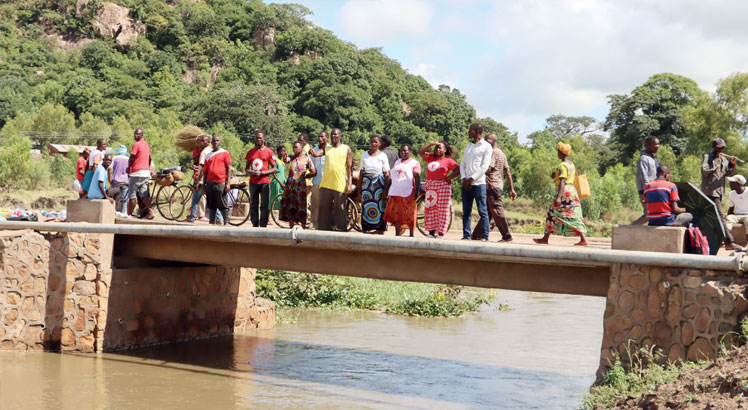
of Sombani Bridge. l Isaac Sikapizye
The area, which is split by a massive gully, is surrounded by highlands.
“When it rains, we pay the price. Water from the hills ends floods the gully,” he says.
In 2023, floods caused by Cyclone Freddy killed a six-year-old schoolchild and widened the gully, burying irrigation fields in rocks and sands.
Chitsanzo Club used its K3.7 million and an additional K2.8 million to construct a bridge on the gully where the child was washed away.
The bridge is made of planks, rocks and cement.
“This has eased access to schools, markets, farmlands, boreholes, maize mills and other public spaces for all,” says Neli Liyaya, 54.
These initiatives are a result of Group Cash Transfers piloted to lessen the severity of disasters in Phalombe and Blantyre.
The project seeks to enable effective disaster risk management through systems for inter-agency anticipatory action using a multi-hazard and multi-sectoral approach.
It is funded by the European Union Civil Protection and Humanitarian Aid Operations.
Malawi Red Cross Society is implementing the project in partnership with the Government of Malawi, the Danish Red Cross, World Food Programme and the Food and Agriculture Organisation of the United Nations.
Since April 2024, disaster-prone communities in T/A Kaduya and Kaledzera in Phalombe proposed projects likely to lessen the severity and frequency of disasters in their midst.
They aligned their proposals with disaster risk reduction plans, anticipatory action, and disability-inclusiveness.
Seven clubs qualified for preliminary grants ranging from K3.5 million to K4 million.
The groups received their funds from Red Cross just before Cyclone Chido struck in December 2024.
Chikuli Group dug dykes and check dams reinforced by vetiver grass. Madalitso group maintained 46 houses for vulnerable groups in Nampinga Village.
In T/A Kaledzera, Tadala and Mgwirizano clubs rehabilitate battered roads, clearing drains.
In the neighbourhood, Abwenzi Awulamali group rehabilitated 57 thatched houses of people with disabilities and planted Senna acacias trees for timber and windbreaks.
Since 2017, Red Cross has been championing anticipatory action for community resilience as disasters become more frequent and severe amid climate change.
The new approach empower communities to become first responders instead of waiting for government agencies and partners.
According to Malawi Council of Disability Affairs (Macoda), Phalombe district is home to over 3 000 persons with disabilities who are disproportionately affected when disasters strike.
Macoda district rehabilitation officer Pius Chilewani says the project has empowered communities to establish disability-friendly infrastructure and minimise discrimination.
“This project has proved that people with disabilities can contribute to impactful development projects,” he says. “The inclusion of people with disabilities or their representatives in the groups provided space for them to choose what would meet their needs.”
Phalombe disaster risk management officer Florence Harawa says consistent consultations, from community sensitisation to proposal development, have paid the desired dividends.
“Area and village disaster risk management committees as well as village development were trained how to establish effective groups. This was crucial since some of the groups were new while others were merely village savings and loans associations with little to no experience of project implementation,” she says.
Harawa adds that the seven groups’ inroads prove communities have the capacity to solve common challenges if empowered.
“The improved roads, bridges and waterways have improved access to essential services while making communities safer and more resilient,” she says. “The rehabilitation of houses for vulnerable groups, including persons with disabilities, offers safety and allows them to use their money for other essentials such as food.”
Malawi Red Cross Society project coordinator Cecilia Banda says the group cash transfers have made communities proactive—rather than reactive to disaster risks.
“For years, communities were losing a lot of lives and property because they were waiting for disasters to happen before taking action. Clearly, there was a gap between weather forecasts and people’s actions.
The project empower them to take life-saving actions before tragedy strikes, as did groups in T/A Kaduya and Kaledzera in Phalombe.”
The project ends this month.